
A solar array produces most when everyone else's is producing too. That is the awkward arithmetic of the middle of the day: supply peaks together, demand does not, and the price of a kilowatt-hour on the wholesale market falls accordingly. Often it falls below zero.
A site that exports its surplus at that moment is not being paid for it. Depending on the contract, it is paying to be relieved of it. The array still works perfectly. The economics of that particular hour have simply inverted.
Storage moves the hour, not the energy
This is the whole point of putting a battery between an array and a meter. Nothing about the generation changes. What changes is when the electricity is used: kept through the hours it is worth nothing, and released into the hours it is worth the most, whether those are your own peak demand or a favourable moment on the market.
Put plainly: you stop being a price taker on a schedule the weather sets, and you start deciding when your own production gets spent.
The kilowatt-hour you did not sell at a negative price is the cheapest one you will ever use.
What that does to a payback
Marny Energy publishes a comparison of the same site built two ways. With solar and a grid connection alone, the model is a 1.2M€ investment returning 120,000€ a year, and a ten-year payback. With solar and storage, it is a 2M€ investment returning 300,000€ a year, and a six-year payback. The second configuration costs more and pays for itself four years sooner, because the same generation is being sold into better hours.
It is a model, not an invoice: every site has its own load curve, its own tariff and its own reasons. But the mechanism it illustrates does not vary. Storage does not make more energy. It makes the energy you already make worth more.
Sizing it around the load
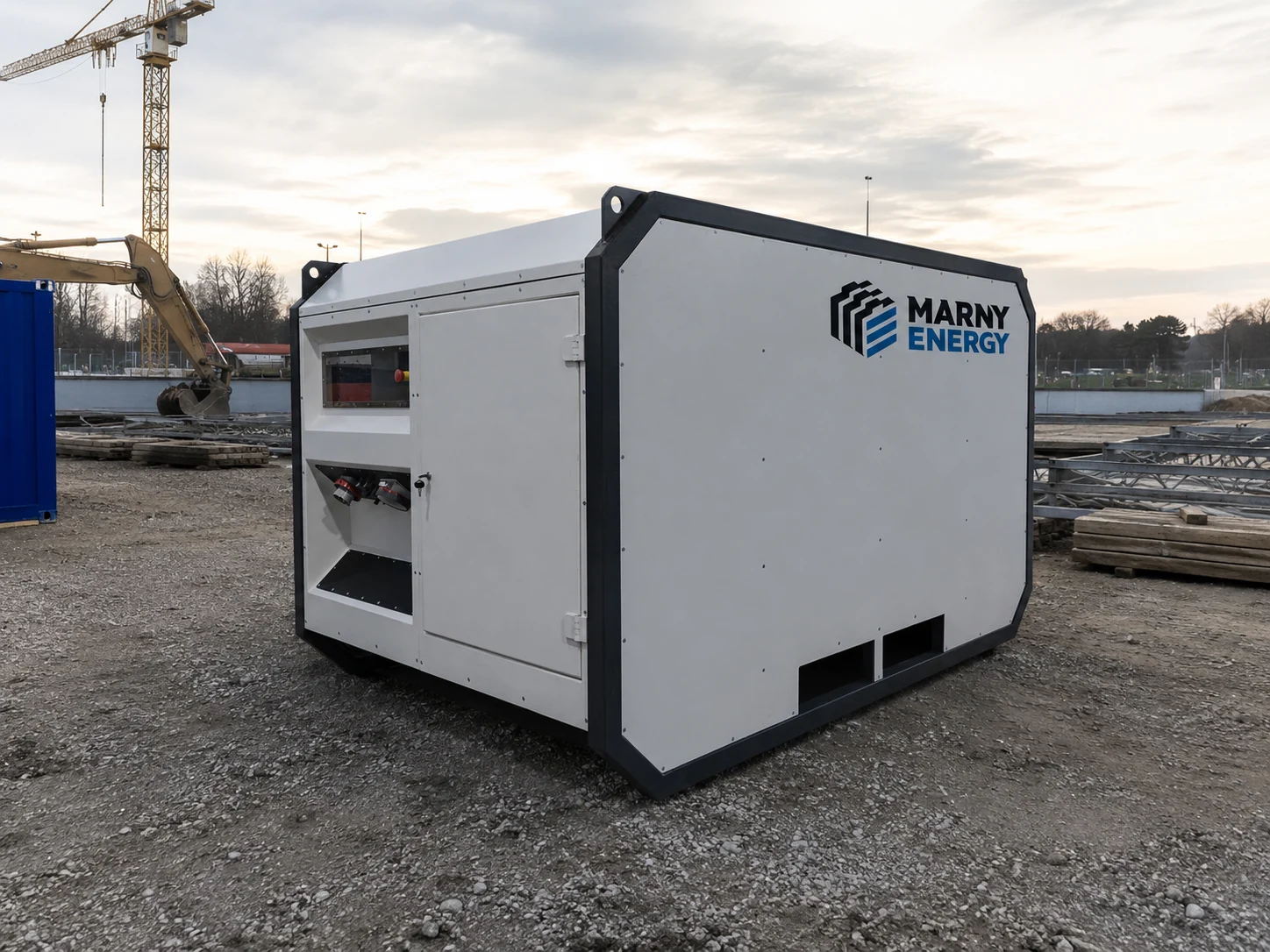
A Battery-Shelter is specified around the site rather than around a catalogue: 40 to 200 kW of power, 120 to 1,000 kWh of storage, and solar input up to 300 kWp, inside a compact modular 10-foot container. The right size is the one that covers the hours that actually cost you something, which is a question about your load curve before it is a question about batteries.